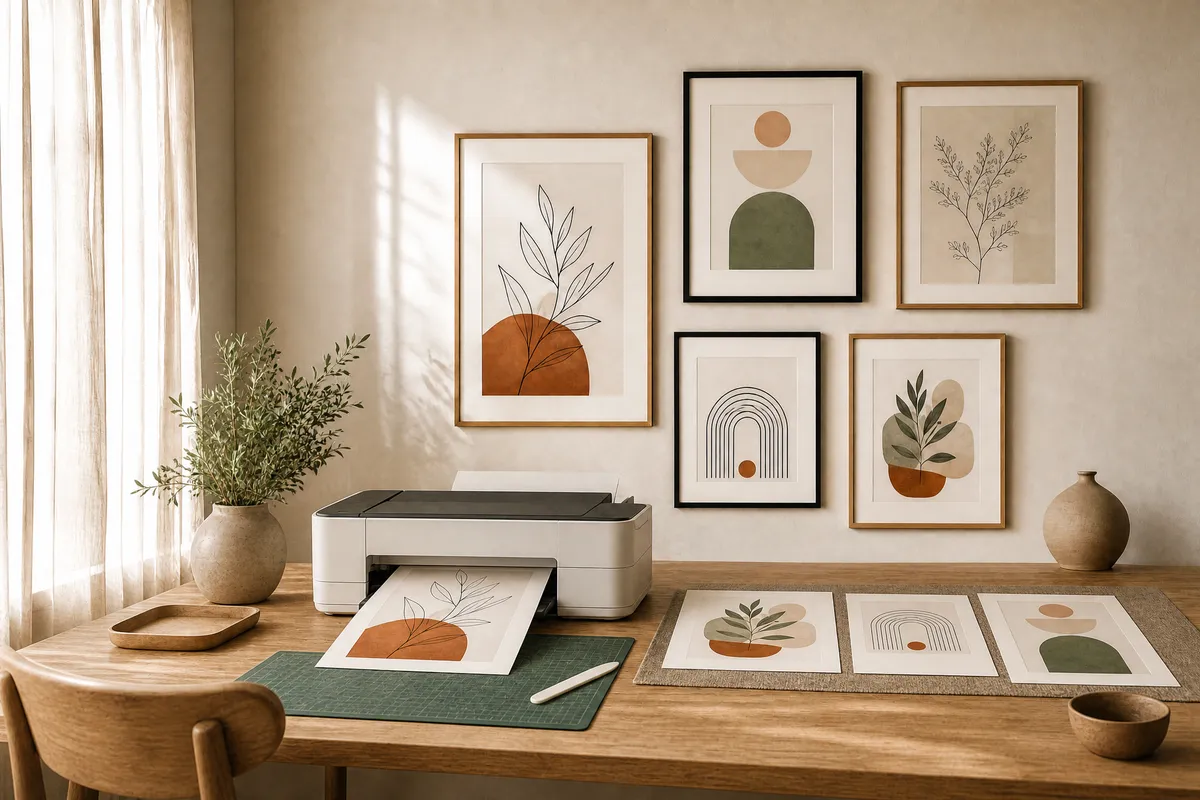
Every printable listing says “print at home or at your local print shop!” as if the two were interchangeable. They’re not. We test print the art we feature — on a mid-range home inkjet, at drugstore photo kiosks, and through online labs — and the honest answer is that each option has a clear territory. Here’s the map.
What does printing at home actually cost?
The per-sheet math looks wonderful and the total math looks worse. Typical ranges (consumer inkjet, good matte paper, mid-2020s prices — treat these as ballparks, not quotes):
| Cost item | Typical range | Notes |
|---|---|---|
| Matte photo paper, A4/8x10 | ~$0.20–0.60 per sheet | Buying 50–100 sheet packs |
| Ink per full-coverage A4 print | ~$0.50–1.50 | Heavily dependent on coverage and printer |
| Total per A4/8x10 print | ~$1–2 | Once you own printer and ink |
| A capable inkjet printer | ~$70–250 | Only worth it if used regularly |
| Full ink/cartridge replacement | ~$40–90 | The hidden recurring cost |
So a single home print is cheap, but the entry ticket isn’t. If you print a handful of pieces a year, the printer and drying ink cost more per print than any lab would charge. If you print monthly — rotating seasonal art, kids’ rooms, gifts — home printing genuinely is the cheapest option per piece and unbeatable on speed: file to wall in ten minutes.
Quality-wise, a decent inkjet on proper matte paper produces framed-art quality at A4/8x10 that most guests will never question. The failure modes are specific: dark, ink-heavy artwork can band or bronze, borderless printing is fiddly on many home printers, and cheap copy paper (the number-one mistake) makes any file look like a flyer.
One more honest limitation: almost no home printer goes beyond A4/US Letter. If the wall needs A3 or larger, the decision is made for you.
What does a print shop or online lab cost?
“Print shop” spans three quite different services:
| Option | Typical cost (8x10 / A4) | Typical cost (large, e.g. 18x24 / 50x70) | Strengths |
|---|---|---|---|
| Drugstore / supermarket photo kiosk | ~$3–6 | ~$15–25 (poster) | Same-day, everywhere; inconsistent color |
| Online print lab | ~$5–15 | ~$20–45 | Best quality-per-dollar at size; fine-art paper options |
| Local independent print shop | ~$8–20 | ~$25–60 | Expert eyes on your file, immediate reprints if off |
Labs and shops win decisively in three situations. Large formats: their machines are built for it, and a 50x70 poster from a lab costs less than the failed experiments of trying to tile it at home. Dark and saturated artwork: pigment printers and color management handle heavy ink coverage without the banding home printers produce. Gifts: paper weight and finish are most of what makes a print feel expensive, and a lab’s 230–300 gsm fine-art stock simply feels like a different product.
The trade-offs are real too: shipping time (or a trip), per-print costs that sting if you reprint often, and kiosks in particular applying automatic “enhancement” that can shift art colors — always untick auto-correction when a kiosk offers it.
So which should I use? The decision table
| Your situation | Verdict |
|---|---|
| A4/8x10 or smaller, light or medium-tone art | Home — cheapest and instant |
| You’ll print 10+ pieces this year | Home — the printer pays for itself |
| A3/11x14 or larger | Shop/lab — most home printers can’t |
| Dark, moody, or color-heavy artwork | Shop/lab — banding risk at home |
| It’s a gift | Shop/lab — paper quality carries the gift |
| You need it on the wall tonight | Home (or drugstore kiosk same-day) |
| One-off print, you own no printer | Shop/lab — never buy a printer for one print |
| Gallery wall of many small prints | Home for drafts, then reprint the keepers at a lab |
That last row is the workflow we actually recommend: home-print cheap drafts to test sizes and placement on the wall, live with them for a week, then lab-print the final versions of the pieces that earned their spot. Drafting is where a home printer earns its keep even if the finals come from a lab.
What file settings matter, wherever you print?
Four settings cover nearly every quality complaint we hear:
Print at 100% scale, never “fit to page.” Fit-to-page quietly stretches or crops the artwork. Choose the file version that matches your target size (a well-made printable includes several ratios — the sellers who do this well, our own shop Linoraprint among many on Etsy, list the included sizes right in the listing).
Use the JPG for kiosks, the PDF for home printing. Kiosk machines want JPGs; home printer dialogs handle PDFs more predictably at exact sizes.
Pick “photo” or “best” quality plus the correct paper type in the driver. Telling an inkjet it’s printing on plain paper while feeding it matte photo stock is the single most common cause of washed-out prints.
Let prints dry before framing. Ten minutes minimum for inkjet output; sandwiching a damp print under glass causes sticking and haze.
For paper choices in depth — weights, matte versus luster, when cotton rag is worth it — see the paper section of our complete printable wall art guide.
The bottom line
Neither option is “the right way.” Home printing is a convenience machine: instant, cheap at small sizes, perfect for iteration and rotation. Print shops are a quality machine: better paper, better color, the only route to large formats. Most people who live with printable art end up using both — and the decision table above tells you which one this particular print deserves.
Pin this guide
Save any of these to your Pinterest boards — they link straight back to this guide.
Pin 1 of 2 — save to Pinterest 
Pin 2 of 2 — save to Pinterest