
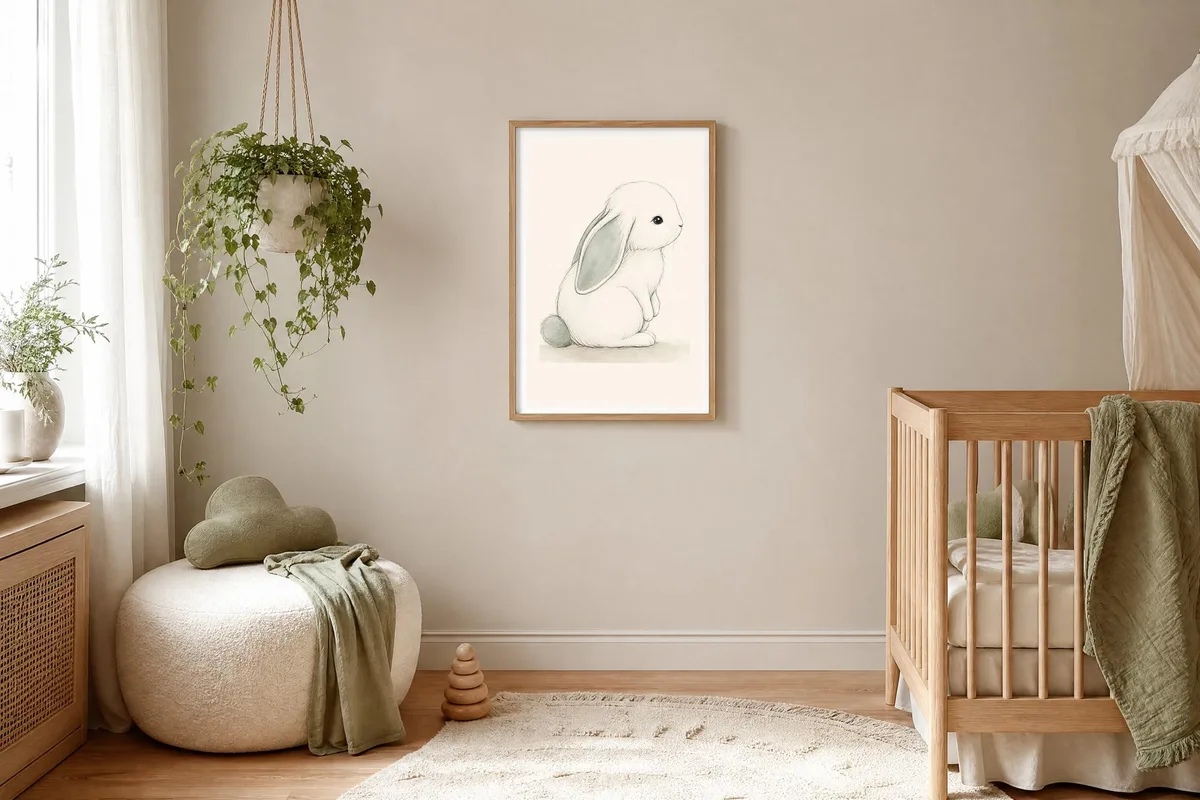
Three separate bodies in three countries say so in their own wording. The American Academy of Pediatrics tells parents to limit over-the-crib wall decorations to painted walls and wallpaper. Australia’s consumer regulator says to settle a baby away from hanging frames and floating shelves. Health Canada says to place the crib away from wall hangings.
We sell prints, and this is the guide that tells you where not to hang one.
The three sentences this guide is built on
The strongest of the three is the American Academy of Pediatrics, on its parent site HealthyChildren.org, in a page on suitable sleeping sites last updated 25 May 2023. Under the heading “Crib placement”:
Knowing that it won’t be long before anything and everything within reach will be fair game, we also recommend limiting your over-the-crib wall decorations to painted walls and wallpaper. Picture frames and mirrors over cribs may be cute, but they are also injuries waiting to happen.
The second is a regulator. Product Safety Australia, run by the Australian Competition and Consumer Commission, publishes a page on how to settle baby to sleep safely. Its list of things to put a baby to sleep away from includes a bullet that reads:
hanging frames or floating shelves, to prevent injuries from falling furniture
The third is Health Canada, on cribs, cradles and bassinets, published 20 November 2024 and modified 3 November 2025. Setting up a cot, it says to place it away from items that may be unsafe, and its printed list runs: lamps, curtains, windows, blind cords, patio doors, wall hangings, other furniture, and electrical cords. “Wall hangings” is left unqualified, which means it covers a framed print without anyone having to argue about it.
Two of those three are national consumer regulators, and the three of them wrote on three different continents without citing one another.
What none of them say
This is the point where most articles on the subject start inventing.
None of these sources gives a distance in centimetres between a cot and a picture, and none gives a weight limit. None of them says a frame becomes acceptable once it is screwed to the wall, or because it is lightweight, or because the glazing is acrylic, or because you live somewhere that does not have earthquakes. The hazard the ACCC names is falling furniture, and none of the three distinguishes between materials.
So there is no number for that gap here either. What they actually print is the whole of it: the span of wall above the cot is paint and wallpaper only.
It is also worth saying who is quiet. The US Consumer Product Safety Commission, the NHS, the Lullaby Trust and RoSPA were all read for this guide. Their safe-sleep pages cover cords, windows, mattresses and soft bedding, and they say nothing at all about wall art. Anyone telling you that the NHS has a rule about pictures over a cot is making it up.
Measure your own cot, because there is no standard one
The span you need to keep clear is the cot’s own, so measure the cot you bought. There is no single European figure to copy.
The cot photographed for this guide is an IKEA SNIGLAR. Its Hungarian product page gives an overall length of 124 cm, a width of 66 cm and a height of 80 cm, with a sleeping surface of 60 x 120 cm, and carries the line “Megfelel az európai EN 716-1 szabványnak”, meaning it complies with the European standard EN 716-1. The same cot on IKEA’s Korean site is listed at 123 cm long, so even one model moves by a centimetre between markets.
EN 716-1 itself does not fix a size. BSI lists the current edition as BS EN 716-1:2017, and its scope covers cots with an internal length greater than 900 mm but not more than 1 400 mm. That is 90.0 cm to 140.0 cm of permitted internal length, a 50 cm band rather than a standard.
The United States answers differently again. Federal law there sets a minimum full-size crib mattress, and 16 CFR part 1241 states it in both units:
The dimensions of a full-size crib mattress shall measure at least 27 1/4 in. (690 mm) wide and 51 5/8 in. (1310 mm) long.
Converted exactly, at 2.54 cm to the inch: 27.25 x 2.54 = 69.215 cm wide, and 51.625 x 2.54 = 131.1275 cm long. The rule’s own metric figures, 69.0 cm and 131.0 cm, are the rounded versions of those. Against a European sleeping surface of 60 x 120 cm, that is roughly 9 cm wider and 11 cm longer.
| Cot figure | As published | In centimetres |
|---|---|---|
| IKEA SNIGLAR, overall | 124 x 66 x 80 cm | 124 x 66 x 80 cm |
| IKEA SNIGLAR, sleeping surface | 60 x 120 cm | 60 x 120 cm |
| EN 716-1 scope, internal length | 900 mm to 1 400 mm | 90.0 cm to 140.0 cm |
| US full-size crib mattress, minimum | 27 1/4 in x 51 5/8 in | 69.215 x 131.1275 cm |
Put the tape along your own cot, write the number down, and treat that strip of wall as unavailable.
The walls that are left
Everything from here is this guide’s own judgement about rooms, not advice from a safety body, and it is worth keeping those apart.
A nursery usually has four candidate walls once the cot has claimed one. The wall opposite the cot is what an adult sees from the doorway and what a baby faces while being carried around the room. Above a chest of drawers or a changing unit works too, and it comes with a useful constraint already built in: the AAP asks you to keep the cot no less than an arm’s reach from nearby dressers and tabletops, which puts that furniture, and anything over it, clear of the sleep space by construction. Behind a feeding chair is the wall you will end up staring at for the longest. The short wall beside the door takes a single piece well, because it gets seen in passing rather than studied.
One more thing worth knowing before you plan the room around the cot at all. The NHS says that for the first six months the safest place for a baby to sleep is in a cot in the same room as the parents. For a good while the nursery may be where the baby is changed, fed and played with rather than where the baby sleeps.
What a baby can actually see from in there
Decor copy makes confident claims about infant vision. The bodies that study it are more careful than the copy is, and they do not agree with each other, so here is each one in its own words.
The American Academy of Pediatrics, on how your newborn behaves, says a baby’s vision “will be best within an 8- to 12-inch (20.3 to 30.5 cm) range”. Those are the page’s own centimetres; the exact conversions are 8 x 2.54 = 20.32 cm and 12 x 2.54 = 30.48 cm.
The American Optometric Association, writing on infant vision from birth to 24 months, puts the range slightly tighter: a newborn’s “primary focus is on objects 8 to 10 inches from their face or the distance to the parent’s face”. That is 8 x 2.54 = 20.32 cm to 10 x 2.54 = 25.4 cm.
The American Academy of Ophthalmology, on vision development in the first year, published 20 July 2026, goes much wider. At about a month old a baby “may still prefer brightly colored objects up to 3 feet away”, which is 3 ft = 36 in, and 36 x 2.54 = 91.44 cm. The same page adds that infants “are able to see across a room even at birth, but they are mostly interested in objects very close to them”.
Three respected bodies give three different distances for the same first weeks of life. An article that hands you one confident number has picked a favourite without telling you.
Two things they do broadly agree on. Colour is not absent at birth and it is not finished either: the AAO says that by about five months a baby has “good color vision at this point, though not quite as fully developed as an adult’s”, and the AOA says “it is generally believed that babies have good color vision by 5 months of age”. The popular line that newborns see only in black and white is not what either of them says.
And on contrast, the AAP writes that young infants shown “a pattern of black and white or sharply contrasting colors may study them with interest”, while a picture “with lots of closely related colors” is likely to get no response at all. That is a statement about what holds attention. None of the three bodies cited here says that high-contrast imagery improves development, and no trial of it in healthy full-term babies at home turned up for this guide.
For a wall, the consequence is modest. A print on the far side of the room sits several times further away than any of those three ranges, which makes it decoration for the adults for the first months, and that is a good enough reason to buy one on its own.
The cord is the part people get wrong
If something near a cot is going to hurt a baby, the sources are far more worried about what dangles than about what hangs flat.
The AAP’s checklist for making a baby’s room safe is blunt: “Don’t let strings or cords dangle in or anywhere near the crib.” On mobiles it asks for them to be securely attached to the side rails, wall or ceiling, hung high enough that the baby cannot pull them down, and removed “when he is able to get up on his hands and knees, or is 5 months old, whichever comes first”. Health Canada says the same, in its own phrasing, about removing mobiles and toy bars once a baby can sit upright or push up.
Red Nose Australia, whose guidance the ACCC pages point to, extends it past mobiles to the soft decoration people hang around a cot:
Also refrain from hanging mobiles, bunting or other items near the cot, as there is always a risk these items can fall into the cot.
That covers garlands, pennants and name banners, which is the category this blog is least likely to sell you and most likely to see in a nursery photograph.
What this guide refuses to give you
There is no nursery hanging height here, because no source has one. Our guide to the 57-inch rule in centimetres lands on a 145 cm centre line for general rooms, and that number comes from decor publishers rather than from any museum or standards body, which that guide says plainly. None of the paediatric or regulatory sources read for this post gives a height for a child’s room, so applying 145 cm in a nursery is a convention borrowed from a living room, nothing more.
There is also no glass-versus-acrylic verdict here. No standards or safety body guidance on frame glazing in a child’s room turned up. The US mandatory glazing standard covers doors, storm doors, shower enclosures and sliding glass doors, and says nothing about picture frames. Where the authorities do speak, they speak about position and about things falling, and none of them offers a material that makes the position acceptable.
The print in the photographs
The piece on the wall above is Woodland Nursery Decor, a pencil-and-wash rabbit in sage and off-white, hung alone on the open wall with the cot well out to one side. It is from our own shop, which is why it is in the pictures.
Hang it where the baby gets carried past it and where you will see it during a night feed. The strip of wall above the cot stays paint, and that is the one instruction in this guide that came from a paediatric academy and two regulators rather than from us.
Pin this guide
Save any of these to your Pinterest boards. They link straight back to this guide.
-
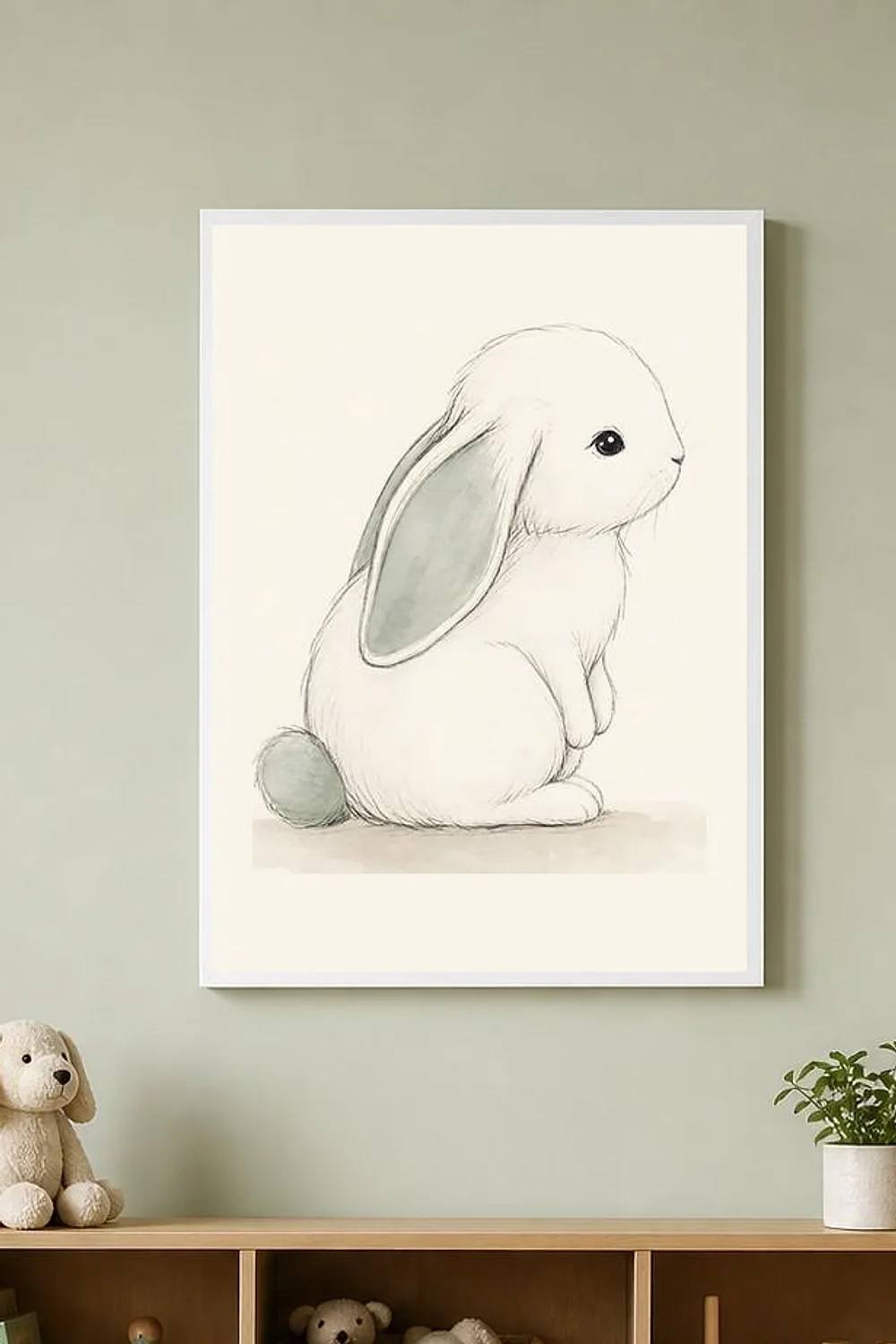
Pin 1 of 2, save to Pinterest -
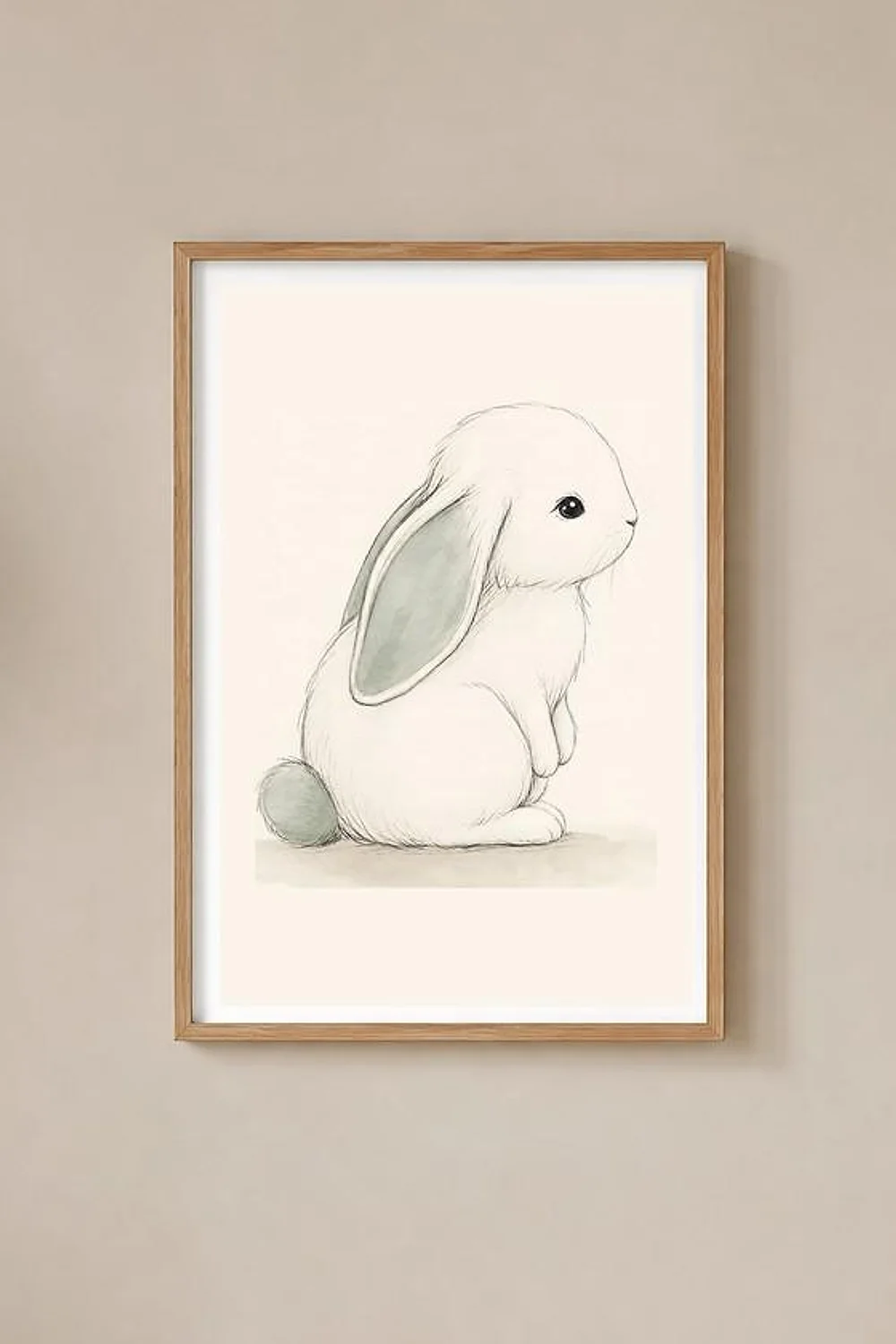
Pin 2 of 2, save to Pinterest