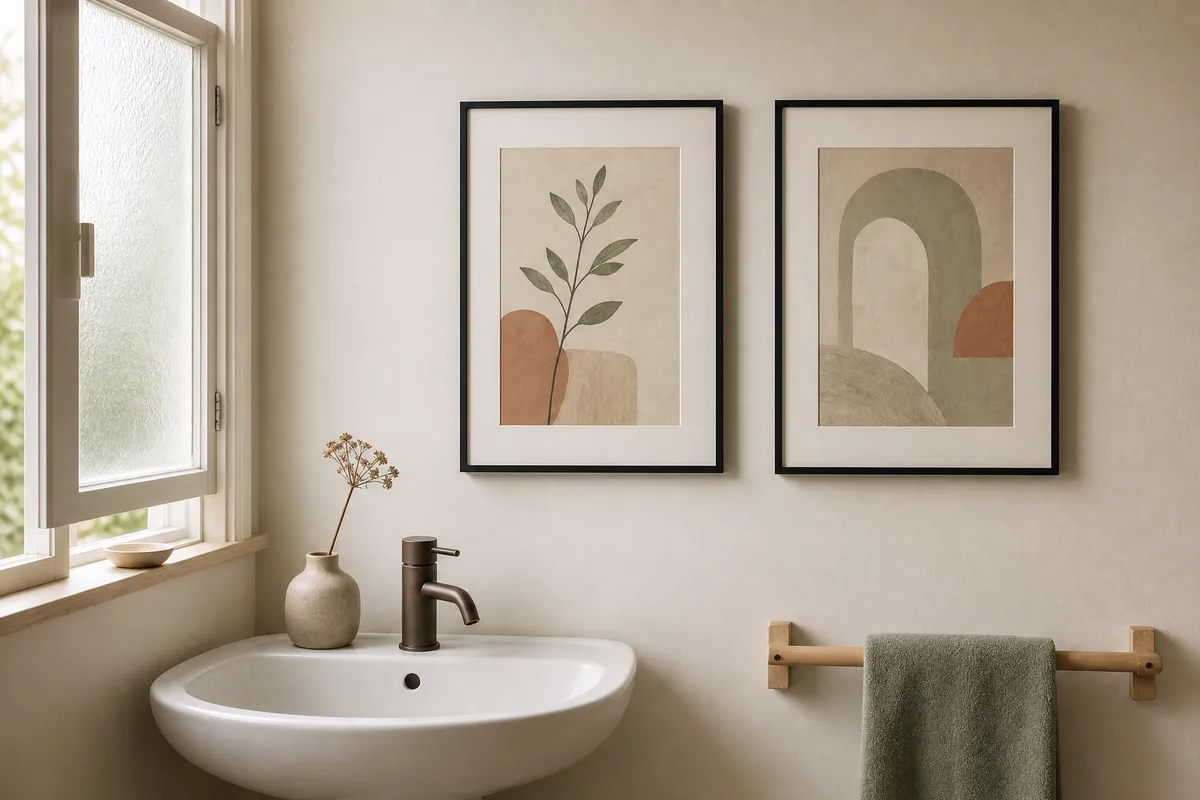
What the damp is actually doing
Paper is hygroscopic. It takes moisture out of the air and gives it back, and it changes dimension slightly each time it does. That cycle is the whole problem, and it shows up in three separate ways.
The first is cockling — the gentle waviness that appears across a sheet that has taken up moisture unevenly. It is the earliest visible sign and, on an unmounted print behind glass, usually the first thing you notice.
The second is the mount and the frame moving at a different rate to the paper. A print that is fixed at all four corners onto a backing board has nowhere to go when it expands, so it buckles forward. This is why a print can look fine for a year and then suddenly develop a ripple that will not flatten out.
The third is mould, and that one has a threshold rather than a gradient.
The numbers worth knowing
Two authorities, two different jobs, and together they frame the decision.
The Library of Congress, describing proper storage of works on paper, asks for “a cool (room temperature or below), relatively dry (about 35% relative humidity), clean, and stable environment,” and says explicitly to avoid “attics, basements, and other locations with high risk of leaks and environmental extremes.” It also asks for minimal exposure to all kinds of light and no exposure to direct or intense light, and for distance from radiators and vents.
The US Environmental Protection Agency, writing about houses rather than archives in A Brief Guide to Mold, Moisture and Your Home, gives the household ceiling: “keep indoor humidity below 60 percent (ideally between 30 and 50 percent) relative humidity.” The EPA also gives the timing that matters most, and it is shorter than people expect: “if wet or damp materials or areas are dried 24-48 hours after a leak or spill happens, in most cases mold will not grow.”
Put those side by side and the bathroom problem states itself. Archival conditions want about 35% RH. A household ceiling is 60% RH. A bathroom during and immediately after a shower spends time well above that ceiling. Nobody is going to run a dehumidifier to protect a print.
But look at the EPA’s 24 to 48 hour window again, because it is the reason bathroom art is viable at all. The damage clock is not about touching high humidity. It is about staying there. A bathroom that spikes to high humidity for twenty minutes and then dries out is a fundamentally different environment from one that never dries.
The single thing that decides it: does your bathroom dry out?
Everything below follows from this, so answer it honestly before you buy anything.
The EPA’s own bathroom guidance is to “run the bathroom fan or open the window when showering,” and it notes that where damp is persistent, increasing ventilation and cleaning more frequently will usually keep mould from recurring.
A bathroom that dries. An extractor that actually pulls, or a window you genuinely open, and surfaces that are dry again within an hour or two. Paper art is fine here with sensible framing. This is most bathrooms.
A bathroom that does not. No extractor or a weak one, no openable window, condensation still sitting on the mirror hours later, or visible mould at the ceiling line or in the grout. Do not hang paper in this room. Fix the ventilation first — that is a building problem, not a decorating one, and a print will simply become another surface for mould.
If you are unsure, a small hygrometer costs very little and settles the question in a week. The EPA notes humidity meters run roughly $10 to $50. Watch how fast the reading falls after a shower rather than how high it peaks.
Three placements that survive, and one that does not
Where you hang it matters more than what you hang.
Away from the shower plume. The wall opposite or beside the door, not the wall the shower sprays toward and not directly above the bath. The plume carries liquid water, not just vapour, and no frame is sealed against that.
Not directly above a radiator or towel rail. The Library of Congress asks for distance from radiators and vents for a reason: a heat source below the frame drives a steep local humidity swing every time it cycles, which is the fluctuation that causes cockling.
Out of direct light. Bathrooms often have a single bright window and reflective surfaces on every side. Minimal light exposure is a conservation instruction, and in practice it is what keeps a print’s colour from going flat within a couple of years.
The one that does not work: the wall inside the shower enclosure or the splash zone of the basin, however well framed. That is liquid water, not humidity, and it will get behind the glazing at the frame edge.
Framing that buys you years
The frame is doing more work in this room than anywhere else in the house.
Let the paper move. Hinge-mount the print at the top edge only, with the bottom and sides free, rather than fixing it down at all four corners or using adhesive across the back. A sheet that can expand and contract will lie flat far longer than one that is held rigid.
Use a window mount with depth. A mount board holds the paper off the glazing, so a print that does cockle slightly is not pressed against a cold surface where condensation forms. Around 1.4 mm board is the common thickness and is enough.
Acrylic glazing over glass. Lighter, does not shatter on a hard tiled floor, and — the practical point in a bathroom — a cold glass sheet is exactly where condensation likes to form.
Do not seal it airtight. The instinct is to tape the back completely closed against moisture. In a room that repeatedly reaches high humidity, a sealed frame traps whatever moisture got in, and the print then sits in a small chamber that never dries. A normally-backed frame breathes with the room and dries when the room dries.
Choose materials that are not already acidic. The Library of Congress recommends acid- and lignin-free folders and mats, available alkaline buffered or neutral pH. Damp accelerates acid damage, so a cheap mount board that would have yellowed slowly in a bedroom will do it visibly faster here.
The strategy nobody wants to say out loud
Print it cheaply and plan to replace it.
This is where a downloadable print has a genuine structural advantage over a bought original, and it is worth being plain about it. If you own the file, replacing a tired print is the cost of paper and ink, not the cost of the artwork. You can keep the frame, keep the mount, and swap the sheet in ten minutes.
That reframes the whole problem. Instead of asking what will survive a decade in a damp room, you can hang something you actually like, accept that it may want replacing in a couple of years, and treat the frame as the permanent object and the paper as consumable.
A practical version of that: keep the file, note the exact print size in centimetres and the paper you used, and put a reminder somewhere you will see it. When the print starts to look tired, you are reprinting a known thing rather than starting the search again.
Paper choice, briefly
Heavier stock resists cockling better than light stock, simply because it is stiffer. Around 200 to 250 gsm is a sensible floor for a framed bathroom print; lighter photo papers ripple sooner.
Matte and satin finishes are more forgiving than high gloss in this room, partly because gloss shows every water spot and partly because a bathroom’s mixed light makes a glossy surface hard to look at anyway.
We are deliberately not naming a specific paper as bathroom-proof. No consumer paper is, the behaviour depends as much on your room’s ventilation as on the sheet, and any blog that gives you a single confident answer here is guessing on your behalf.
The short version
Check whether your bathroom dries out within an hour or two of a shower. If it does, hang what you like, away from the plume and away from the heat source, hinge-mounted behind a window mount with acrylic glazing, on stock of around 200 gsm or heavier, and do not seal the frame. If it does not dry out, sort the ventilation before you sort the wall.
And keep the file. In this one room, replaceable is a feature.
Pin this guide
Worth saving before you buy a frame — the ventilation test and the hinge-mount detail are the two things that decide whether a bathroom print lasts two years or ten.
Pin 1 of 2 — save to Pinterest 
Pin 2 of 2 — save to Pinterest